
 Abosh
A dynamic bottleneck is a constraint that moves between stations as product mix, changeovers, downtime, staffing, material and quality holds change. Averages hide this, because they blend the periods when each station was the limit. To find the current constraint, look at time-based evidence: which station is busiest without being starved or blocked, where queues build, and how that changes by hour, product and shift.
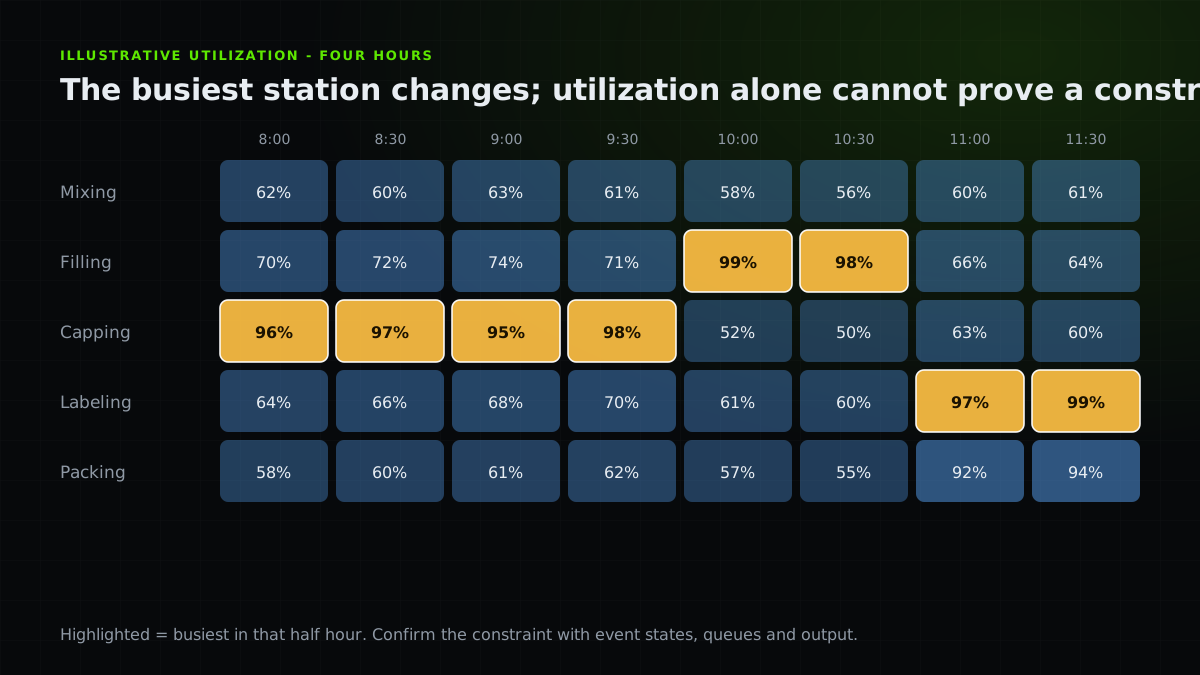
A four-hour example of shifting station utilization
A list of what makes a constraint move
A method that uses event data, not averages
Averages create the illusion of a permanent constraint
An average-capacity table can identify a station to investigate first. Product changes, changeovers and breakdowns alter the capacity available during a shift, so check whether that station actually limits output in the period you need to explain.
The illustrative heat map shows five stations over four hours. The busiest station in each half hour is highlighted, and it changes. Utilization alone does not establish which station limits shipments. Confirm each candidate with working, starved and blocked states, queues and customer output.
What makes a constraint move
Product mix, changeovers, downtime and material availability can change effective capacity during a shift. Check when each condition changes and how it affects the candidate constraint.
| Factor | How it moves the constraint |
|---|---|
| Product mix | Different products take different times at each station. |
| Changeovers | A station that is fast in steady running may be slow during a changeover. |
| Downtime | A failure at one station shifts load and starves the stations after it. |
| Staffing | A manned station can become the limit when a person is absent. |
| Material availability | A station starved of input stops being the limit until material returns. |
| Campaign sequence | The order of products changes when each station’s peak load arrives. |
| Quality holds | A hold downstream can block a station that was not the limit before. |
How to detect the current constraint
Review events in short time windows. A station that keeps working while a queue builds in front of it may be the constraint, but busyness alone is not enough. Check starvation, blocking and the effect on line output before choosing it.
- Slice by time
Calculate station load in short windows such as 30 minutes or one order.
- Exclude idle causes
Separate time spent working from time starved or blocked.
- Read the queues
A growing queue in front of a station and an empty one after it is the classic sign.
- Segment
Repeat by product, shift and changeover state to see when the answer changes.
- Recheck
After every change, repeat. See bottleneck analysis.
Why this changes what you improve and how you schedule
If the constraint moves, improvement projects aimed at a single machine pay off only part of the time. The better targets are often shared: changeover methods, material flow, response to stops and schedule rules.
It also changes scheduling. A schedule that protects one station can starve another that becomes the limit under the next product. Production scheduling optimization covers how to test sequences against several constraint states, and the theory of constraints explains the exploit-and-subordinate logic behind it.
When a static capacity spreadsheet is enough, and when it is not
A capacity table may be sufficient for a stable line with one product and a large capacity gap between stations. When mix, changeovers or smaller gaps change the result, inspect event records and test scenarios. A digital twin or simulation can help compare those conditions. Manufacturing data analytics covers the records needed to check them.
A related example from Abolfazl
Abolfazl connects release decisions, queues and launch lead time.
In English, on founder Abolfazl’s personal blog. This is related reading, not an independent technical source.
Practical checklist
- Do not name a bottleneck from average capacity alone.
- Calculate load by short time window, product and shift.
- Separate working time from starved and blocked time.
- Look at queues before and after each candidate station.
- Check whether the answer changes with product mix and changeovers.
- Prefer improvements that help whichever station is the limit.
- Recheck the constraint after every change.
- Test schedules against more than one constraint state.
FAQ
FAQ
Sources and further reading
Authoritative references used to research and verify this guide.