
 Abosh
A Gemba walk means going to where work happens to understand the current process through observation and questions. Choose one customer problem, follow a real job and ask the people doing it about the gaps you see. Record facts separately from explanations. Finish with an owner and a next check, not a list of instant fixes. The method can support Lean, Six Sigma or everyday improvement; the label matters less than what you learn.
Choose a clear purpose and boundary for an observation session.
Record what happened without turning guesses into causes.
Leave with a small follow-up that the team can actually check.
Gemba is a place, not an acronym
The Lean Enterprise Institute translates gemba as the actual place where value-creating work happens. That can be a production line, a dispatch desk or the team handling customer requests. Gemba is also written genba. An English-friendly pronunciation is “gem-buh”, with a hard g.
The walk is a way to understand current work before deciding what to change. Kaizen concerns improvement; the walk can help a team find and understand a problem to improve. A Six Sigma investigation can use the same direct observation alongside its measurements. These are related practices, not competing names for one compulsory sequence.
Observe the work with its operators. An unexplained queue may be waiting for a drawing, an authorized decision or a replenishment signal. Looking at the queue without asking can send the team after the wrong problem.
Plan the visit around one question
Seven-step guides are useful teaching aids, but there is no required seven-step duration for every Gemba walk. Choose a period long enough to see the part of the workflow you need, and arrange follow-up when important conditions are absent. A short visit cannot establish what happens across every shift.
For this fictional example, the question is why a ready maintenance-support request waits before approval. The boundary begins when the request is accepted and ends with a usable decision. The observer follows one request with the requester and reviewer; the purpose is learning, not ranking people.
- Agree the purpose
Tell the team which customer problem you are examining and what is outside the visit.
- Follow actual work
Watch one job and its information cross the relevant handoffs.
- Ask about the difference
Compare what was expected with what happened, without prescribing a cause.
- Keep a checkable record
Separate timestamps and quotations from your interpretation.
- Agree the follow-up
Name who will check the missing evidence and when the team will review it.
An observation sheet needs room for uncertainty
Use one record per observation. Include the job or case, step, time, expected condition, observed condition, the operator’s explanation, evidence still needed and follow-up owner. Avoid collecting personal details the investigation does not need.
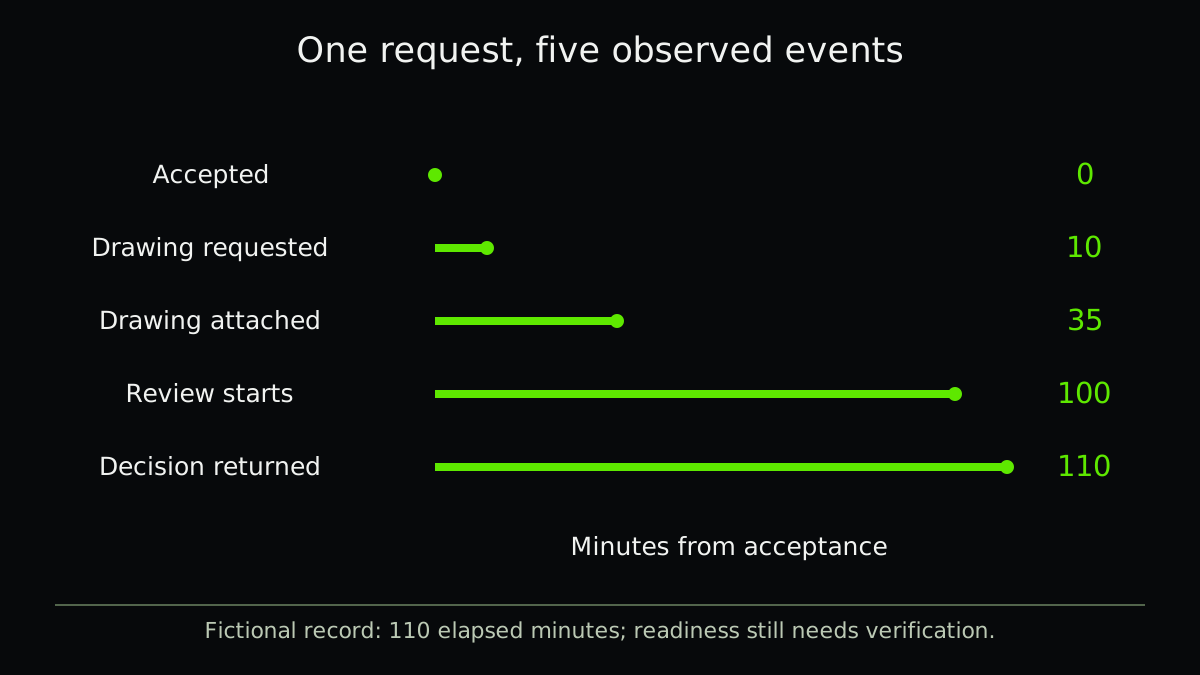
In the fictional record below, the approval screen alone would miss a conversation about a missing drawing. The timestamps locate the delay. They do not prove why the drawing was absent or why the next review slot was late.
| Time | Observed fact | Still to check |
|---|---|---|
| 09:00 | Request accepted | What was checked at acceptance? |
| 09:10 | Reviewer asks for the current drawing | Was the drawing available at the source? |
| 09:35 | Correct drawing attached | Was the packet now fully ready? |
| 10:40 | Review starts | Which work occupied the reviewer? |
| 10:50 | Usable decision returned | Did the requester need another correction? |
Ask a question someone can answer from the work
“Why is this process inefficient?” asks for a judgment. “What information do you need before you can start this review?” asks for something the person can show. Follow with “Where does that information come from?” or “What happens when it is missing?”
Give people room to disagree with the map. A necessary recovery step can look like waste when its purpose is invisible. Ask permission before recording, taking photographs or quoting a person, and follow the site’s access and safety rules. The walk does not authorize entering a restricted area or interrupting a hazardous task.
Turn one finding into a follow-up, not ten promises
Suppose the visit suggests that acceptance does not check drawing revision. The next step could be to inspect several request packets and compare what was available when each was accepted. That is an investigation, not proof that a new form will solve the delay.
If the evidence supports a trial, agree the smallest safe change and its fallback. A PDCA cycle helps connect the prediction and result. A value-stream map keeps the local change connected to the complete journey.
Return to the work after the visit
Tell the team what you learned, what remains uncertain and what happened to its questions. Quietly filing the notes teaches people that the next walk will also lead nowhere.
Check the proposed change under ordinary conditions, including absences, different request types and unresolved cases. The continuous-improvement guide covers that wider loop. The downloadable record here provides prompts; it is not an employee assessment or an approved site audit.
A related example from Abolfazl
Compare active work with waiting in a separate order-flow example.
In English, on founder Abolfazl’s personal blog. This is related reading, not an independent technical source.
Practical checklist
- Choose one customer problem and workflow boundary.
- Explain the purpose to the people involved.
- Arrange safe access and permission for any recording.
- Follow one real job and its information.
- Record expected and observed conditions separately.
- Keep explanations distinct from confirmed causes.
- Assign each useful follow-up an owner and review time.
- Return the findings and check any trial under normal work.
FAQ
FAQ
Sources and further reading
Authoritative references used to research and verify this guide.