
 Abosh
Poka-yoke means mistake-proofing: designing work so an error is prevented or detected early enough for a reliable response. A keyed fixture, a counted kit or a sequence check can help, but each protects a particular failure path. Test missing, wrong, duplicate and look-alike inputs under approved safe conditions. Record what the device should do and what actually happened. A successful normal cycle does not prove that the wrong action is blocked.
Choose a prevention or detection mechanism for a named error.
Plan failure-path challenges before calling a fixture effective.
Keep warnings, bypasses and safety claims within their actual evidence.
Name the error before choosing the device
A reversed connector, missing fastener and wrong recipe are different errors. A countermeasure that catches one may miss another. ASQ’s mistake-proofing guidance distinguishes preventing a mistake from finding it before it becomes a defect.
Kaizen is the wider practice of improvement. A poka-yoke can be one countermeasure developed through that work; it is not the name for the whole improvement cycle. Keep the required function, failure consequence and evidence beside the device.
A four-part kit shows both protection and a gap
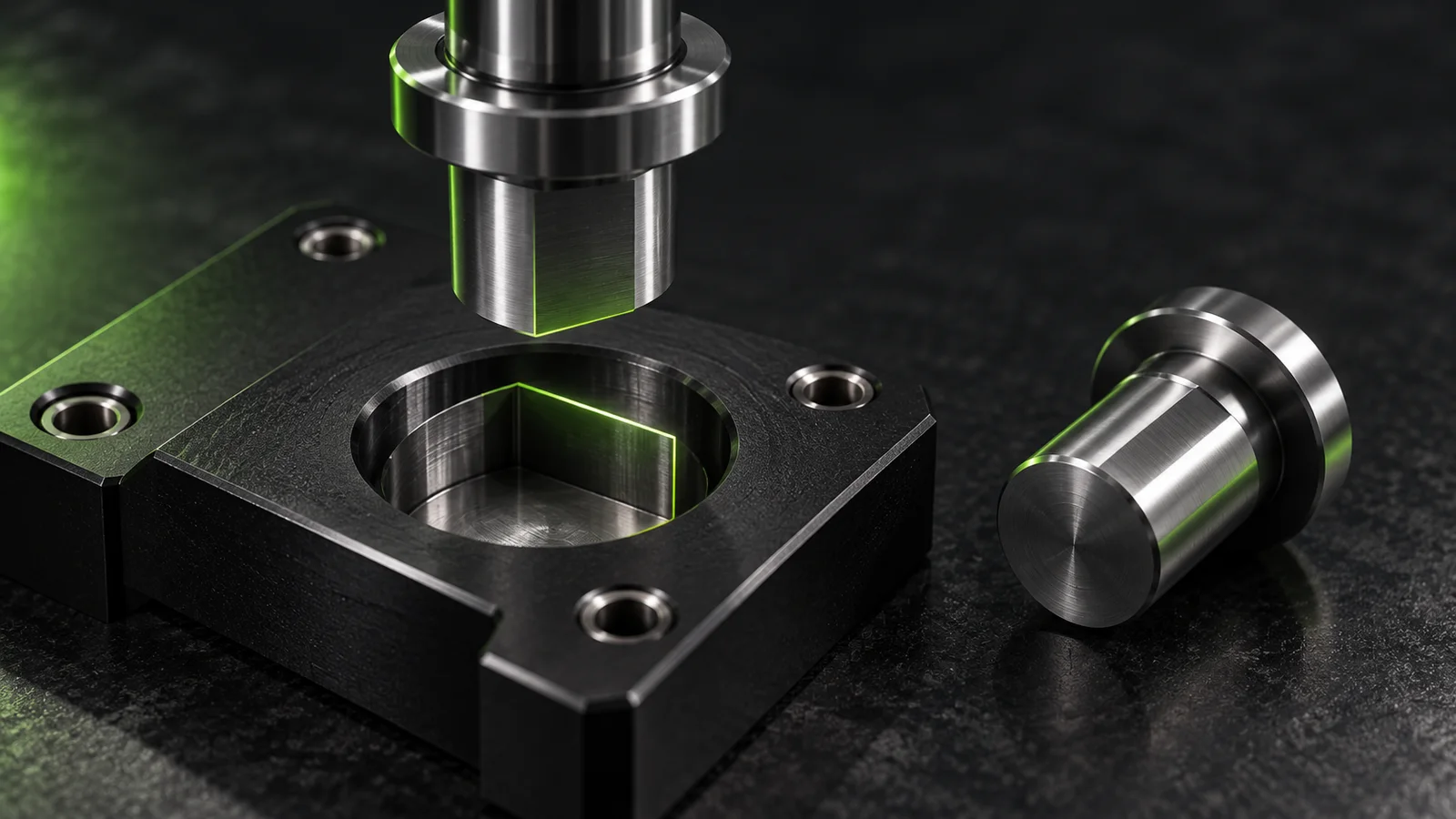
In this fictional kit, four distinct parts each have a fitted recess. The operator can see an empty recess or a differently shaped part. A wrong variant with the same external shape may still fit, so the team must test that failure separately.
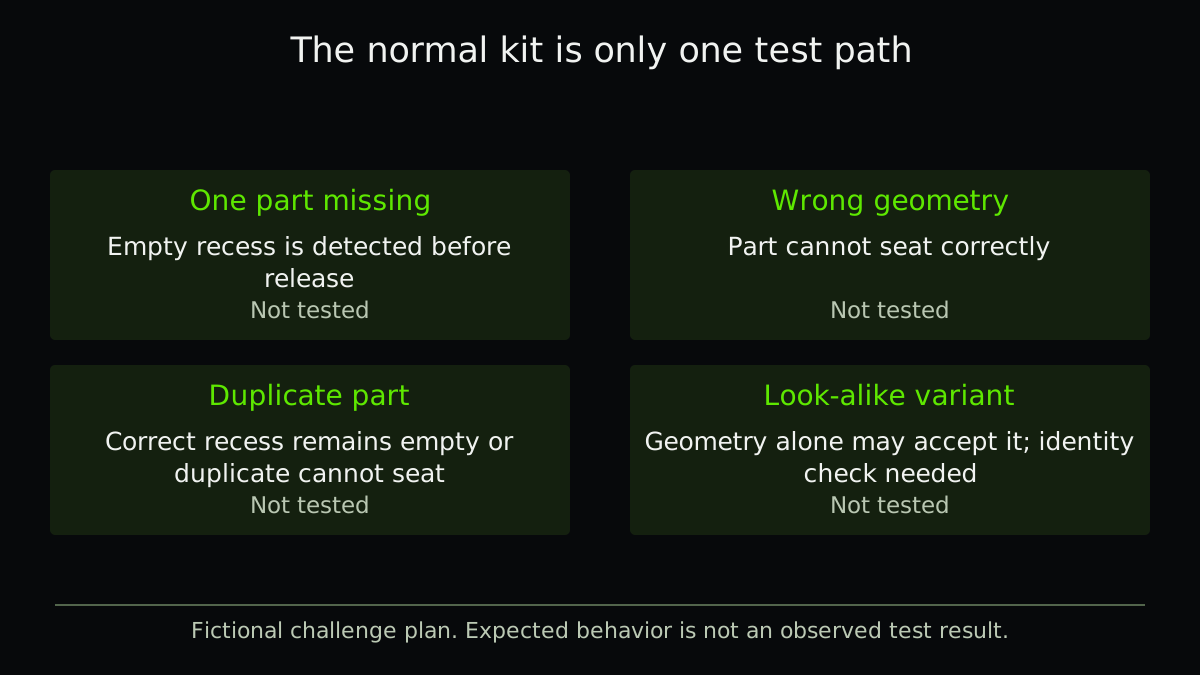
The table is a proposed offline challenge plan, not a test result. Use site-approved conditions and competent review. A general article does not authorize modifying an interlock, bypassing a guard or introducing a fault into live production.
| Challenge | Expected protection | Evidence status |
|---|---|---|
| One part missing | Empty recess is detected before release | Not tested |
| Wrong geometry | Part cannot seat correctly | Not tested |
| Duplicate part | Correct recess remains empty or duplicate cannot seat | Not tested |
| Look-alike variant | Geometry alone may accept it; identity check needed | Not tested |
Different lists describe different functions
Contact checks use physical properties such as shape or position. Fixed-value checks verify an expected count. Motion-step or sequence checks verify that required actions occurred. ASQ presents these as checking methods; they do not by themselves rank every device’s strength.
Lists of six principles vary by source. Do not mix a checking method, an inspection stage and the strength of a response into one supposedly universal list. State whether your countermeasure prevents, detects or only warns, and who must act when it signals.
Check the exception and bypass behavior
A warning depends on someone noticing and responding. A release inhibit depends on the right signal, protected configuration and a safe recovery route. A sensor that checks presence may not verify orientation, identity or quality.
Retain authorized bypasses, maintenance modes, restarts and sensor failures in the review. The FMEA guide helps relate failure consequence to controls; the control-plan guide connects checks with response and responsibility. Neither turns an ordinary quality device into a certified safety function.
Verify the response, then keep it working
Start with an approved offline or otherwise safely controlled challenge. Record the exact input, expected response, observed response, configuration and person reviewing it. A failed challenge stays open; do not average it away with many correct runs.
After a justified trial, maintain inspection, calibration and change-control requirements that affect the device. The standard-work guide supports keeping the usable response with the work. Review again when the part, fixture, software or operating condition changes.
- Define the failure path
Identify the wrong input or action and its consequence.
- Choose the mechanism
State whether it prevents, detects or warns and what remains uncovered.
- Plan safe challenges
Include missing, wrong, duplicate, look-alike and failure conditions where relevant.
- Retain results and control changes
Record failures, authorization, recovery and the next review.
A related example from Abolfazl
Read a different fulfilment example, keeping its rating method separate from yours.
In English, on founder Abolfazl’s personal blog. This is related reading, not an independent technical source.
Practical checklist
- Name the error and required function.
- Keep the failure consequence visible.
- Distinguish prevention, detection and warning.
- Check the wrong and missing inputs.
- Include look-alike variants and duplicates.
- Use authorized safe challenge conditions.
- Record observed results separately from expectations.
- Review effectiveness after relevant changes.
FAQ
FAQ
Sources and further reading
Authoritative references used to research and verify this guide.