

 Abosh
A supplier performance scorecard compares agreed commitments with actual outcomes over a defined period. Keep delivery timing, accepted quantity, quality and issue response separate enough to explain a miss. Supplier qualification asks whether a supplier can meet requirements; ongoing monitoring asks whether it did. Agree the scoring rules with the supplier, keep overdue orders in scope and link the result to an owned action. A weighted headline alone can conceal the failure the operation needs to fix.
Separate supplier selection from ongoing performance.
Calculate delivery and quality using the right populations.
Turn a scorecard discussion into a checked follow-up.
Choose measures from the supply risk
Useful supplier measures can include receipt OTIF, rejected incoming units, actual replenishment-time variation, response to corrective actions and relevant cost. These are choices for a particular relationship, not five mandatory KPIs for every supplier.
A critical single-source component and an ordinary consumable need different attention. Retain the receiving and acceptance boundary. A supplier’s dispatch timestamp cannot prove that the receiving site had usable material.
Keep the promised-order population intact
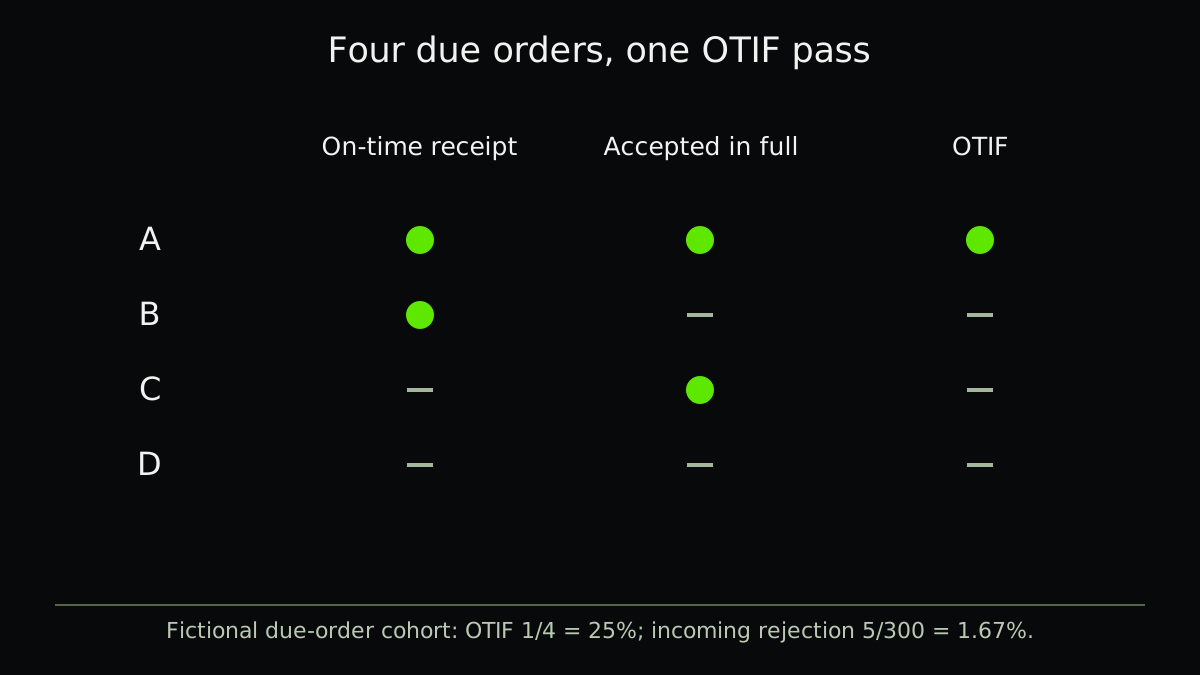
In this fictional period, four orders of 100 units were due. A arrives on time and all 100 units are accepted. B arrives on time but only 95 are accepted. C arrives late within the period and all 100 are accepted. D remains overdue with nothing received.
For this local rule, on time means physically received within the original promised window, and in full means all 100 units accepted by period close. OTIF requires both, including accepted quantity by the promised window. Only A passes both conditions.
| Order | Physical receipt | Accepted units | On time? | In full? |
|---|---|---|---|---|
| A | 100, within promise | 100 | Yes | Yes |
| B | 100, within promise | 95 | Yes | No |
| C | 100, late | 100 | No | Yes |
| D | 0, overdue | 0 | No | No |
Quality uses the receipt population, not ordered volume
Three hundred physical units arrived and five were rejected, so the incoming rejection share is 5/300 = 1.67%, rounded to two decimals. Using all 400 ordered units would dilute the measured incoming quality problem with units that were never inspected.
Keep holds, concessions, later returns and disputed results visible. Define whether a receipt is accepted provisionally or finally. The OTIF calculation guide covers promise and quantity rules; the cost-of-poor-quality guide helps keep consequences separate from a score.
Qualification criteria need their own evidence
CIPS describes evaluating potential suppliers as well as monitoring existing ones, using records, site assessment or third-party evidence where appropriate. Selection may examine capability, capacity, quality controls, financial exposure and other relevant risks. A delivery scorecard does not replace that decision.
Lists called five criteria or ten Cs vary. Without a named source and version, do not treat the count as a universal purchasing standard. State the criterion, evidence required and approval responsibility. A certificate alone does not show that the particular part, route and capacity meet your need.
Review one miss with the supplier
For B, establish what caused the five rejected units and whether containment protects the next receipt. For C, inspect the original promise, release readiness, dispatch and receiving delay. A late receipt may involve more than one organization.
Agree a responsible person, next evidence and review date. Keep the original promise alongside approved revisions rather than rewriting history. A control plan connects a relevant process characteristic to its check and response.
- Agree the score rules
Name due orders, promise revision, acceptance and cancellation treatment.
- Reconcile the records
Resolve missing receipts and holds without dropping overdue orders.
- Select a consequential miss
Follow the underlying order and quality evidence together.
- Check the response
Review recurrence and customer effect, not merely action closure.
A related example from Abolfazl
Compare promise dates and unit identities before joining delivery percentages.
In English, on founder Abolfazl’s personal blog. This is related reading, not an independent technical source.
Practical checklist
- Define the supplier, item and receiving boundary.
- Retain every order due in the period.
- Freeze and identify the promised window.
- Define accepted quantity and open quality holds.
- Calculate OTIF from matching order outcomes.
- Use inspected receipts for incoming rejection rates.
- Keep qualification separate from performance scoring.
- Agree an owner, evidence and review date for each useful action.
FAQ
FAQ
Sources and further reading
Authoritative references used to research and verify this guide.