

 Abosh
Workflow automation coordinates a process across tasks, systems and people. RPA automates repetitive application interactions, often where suitable integration is missing. AI can assist with variable information, but its uncertainty creates additional review and control needs. Choose from the failure you need to remove, not the newest label. Before scaling, test exceptions, retries, ownership and recovery. A faster normal path is useful only if it does not multiply errors or leave difficult cases unattended.
Distinguish process coordination, application tasks and uncertain decisions.
Test duplicate requests and changed payloads before automatic action.
Calculate net capacity under declared assumptions, not promotional ROI.
Choose the smallest reliable mechanism
A workflow can route approvals and exceptions. An API integration exchanges structured records through a supported interface. An RPA bot can perform repetitive screen-level tasks. IBM’s BPA explanation places these techniques within a broader process rather than treating RPA as all automation.
IBM’s RPA guidance distinguishes attended and unattended work. Attended work involves a person; unattended bots run assigned tasks without someone clicking each step. A hybrid arrangement combines the two. These three descriptive labels are not a universal standard or proof that a particular process is safe to automate.
AI has not made every deterministic task obsolete
A stable rule can be checked directly. A model handling varied text may need confidence limits, human review and a fallback. Agentic AI may coordinate actions, but that does not make it automatically better than a bounded bot or API for a repeatable transaction.
Keep authorization and business rules outside an uncertain model’s unsupported judgment. Assess which inputs vary, which decisions require discretion and what a wrong action would cost. The agentic-AI guide covers those control boundaries; the tool label alone cannot settle the choice.
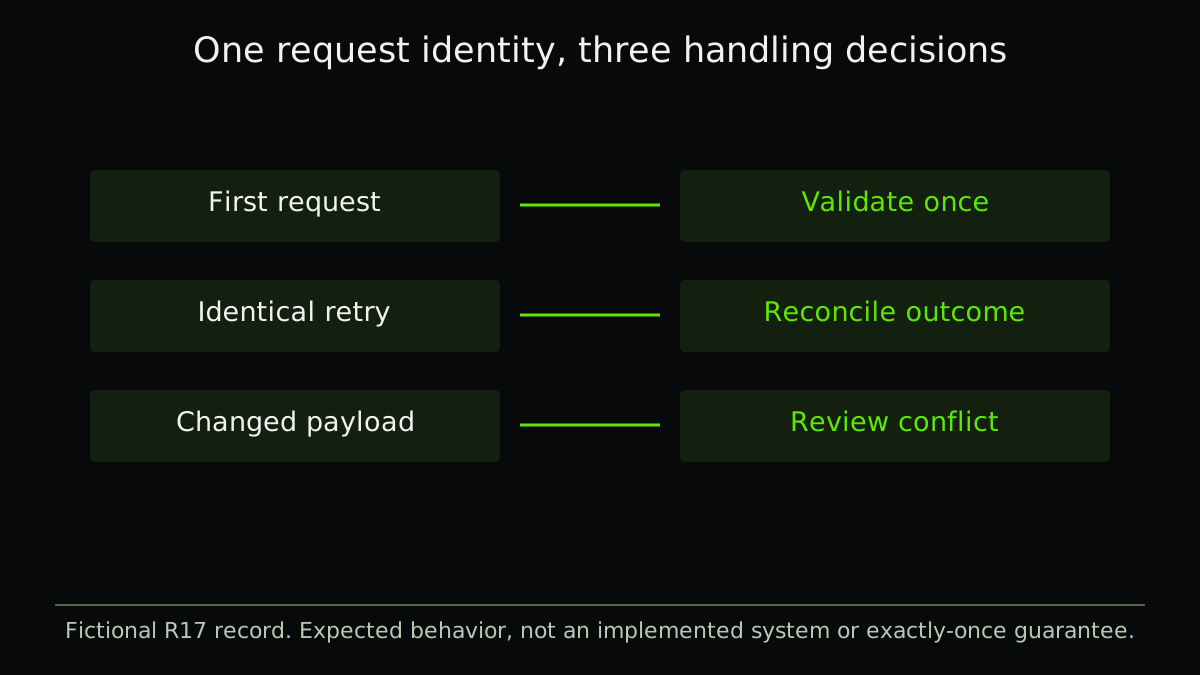
A retry must not create a second order
In a fictional flow, request R17 arrives at 09:00 and an identical retry arrives at 09:01 after an uncertain acknowledgment. The intended business outcome is one accepted request, not two orders. At 09:02 another message uses R17 but contains a changed quantity. That conflict needs a defined review, not an automatic assumption that the payload is identical.
Microsoft’s Service Bus duplicate-detection documentation shows a message-ID history mechanism within a configured window. It does not compare payloads or guarantee exactly-once business effects. The receiving application still needs a stable business identifier, conflict handling and a safe retry/recovery design. This is a design example, not a recommendation to enable a paid messaging feature.
| Time | Fictional input | Expected business handling |
|---|---|---|
| 09:00 | R17, first request | Validate and record one outcome |
| 09:01 | R17, identical retry | Return or reconcile existing outcome |
| 09:02 | R17, changed quantity | Hold conflict for authorized review |
Subtract upkeep and exception work from the benefit
Suppose 30 fictional cases each need 12 minutes today: 360 minutes. A proposed route needs 3 minutes per case plus 60 minutes of upkeep over the same measurement period: 90 + 60 = 150 minutes. The conditional net release is 210 minutes of capacity.
The proposal assumes unchanged case scope and quality, with no additional exception work beyond those inputs. Test that assumption. Released minutes become cash savings only through a real cost mechanism; do not multiply them by a salary rate and quietly call the result banked savings.
Pilot the failure paths before expanding the normal path
Choose a reversible low-risk slice with clear ownership. Include missing inputs, repeated requests, changed records, access failure and recovery after interruption. State when the system stops and asks someone rather than taking another action.
A process discovery record helps expose the handoff. The digital transformation guide keeps changed work and adoption separate from installing software. Review the actual exception burden before widening the scope.
- Map the real handoff
Include waiting, missing inputs and the person receiving the result.
- Select a bounded mechanism
Prefer a supported deterministic rule or interface where it fits.
- Challenge retries and exceptions
Verify business identity, permissions, conflict handling and recovery.
- Measure the complete effect
Include upkeep, corrections, quality and unresolved cases in the same period.
A related example from Abolfazl
Compare a bounded automation candidate with the work and upkeep it requires.
In English, on founder Abolfazl’s personal blog. This is related reading, not an independent technical source.
Practical checklist
- Define the customer outcome and boundary.
- Separate stable rules from uncertain judgments.
- Prefer supported interfaces where appropriate.
- Keep authorization explicit.
- Use stable business identifiers and conflict handling.
- Test retries, interruption and recovery.
- Name a human owner for unresolved cases.
- Measure net capacity, quality and actual cost separately.
FAQ
FAQ
Sources and further reading
Authoritative references used to research and verify this guide.