
 Abosh
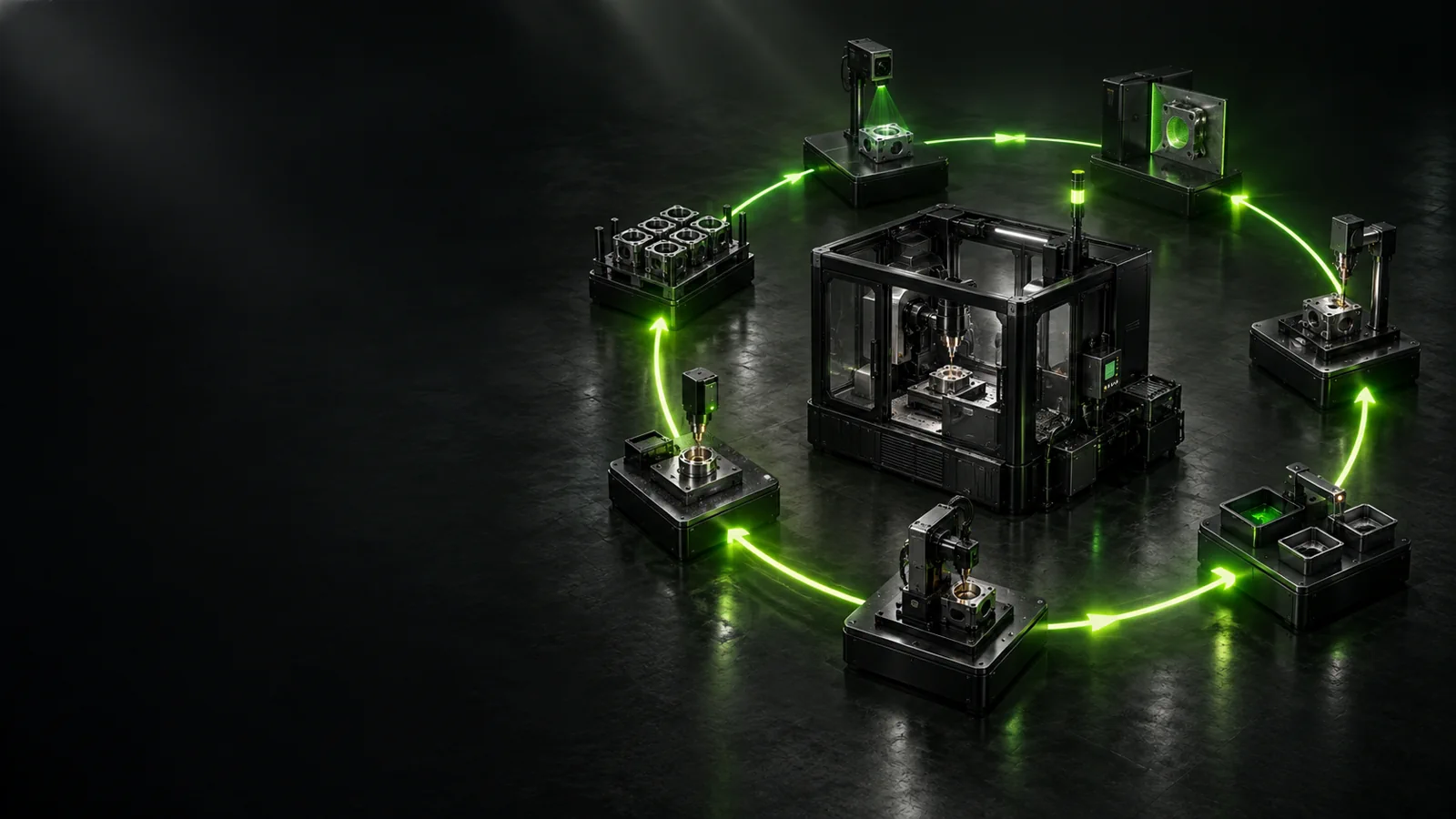
AI for continuous improvement means using AI to shorten the loop between a repeated loss and a verified change: detect the pattern, frame the gap, diagnose causes, model the trade-offs, design a small experiment, verify the result and update the standard. AI may reduce the time spent gathering and analyzing records. People still choose the problem, check causes, approve safe changes and judge the result. Measure any time saved alongside the quality of those decisions.
A seven-step loop you can map to your current process
A clear split between what AI speeds up and what people own
Why most AI in manufacturing misses the improvement loop
Choose the investigation task AI should help with
Common manufacturing AI applications include predictive maintenance, vision inspection and forecasting. Those matter, and each solves one bounded problem. Continuous improvement is a different job: it is the repeating system by which a plant finds, tests and standardizes better ways of working.
Before adding AI, measure the time your team spends detecting repeated losses, assembling records, comparing causes and estimating trade-offs. Choose one task to test. Compare the time spent and the quality of the result with the current method, including the time people need to check the AI output.
The closed loop, step by step
The loop has seven steps. AI helps most in the first four and in verification. The people who work the process own every decision.
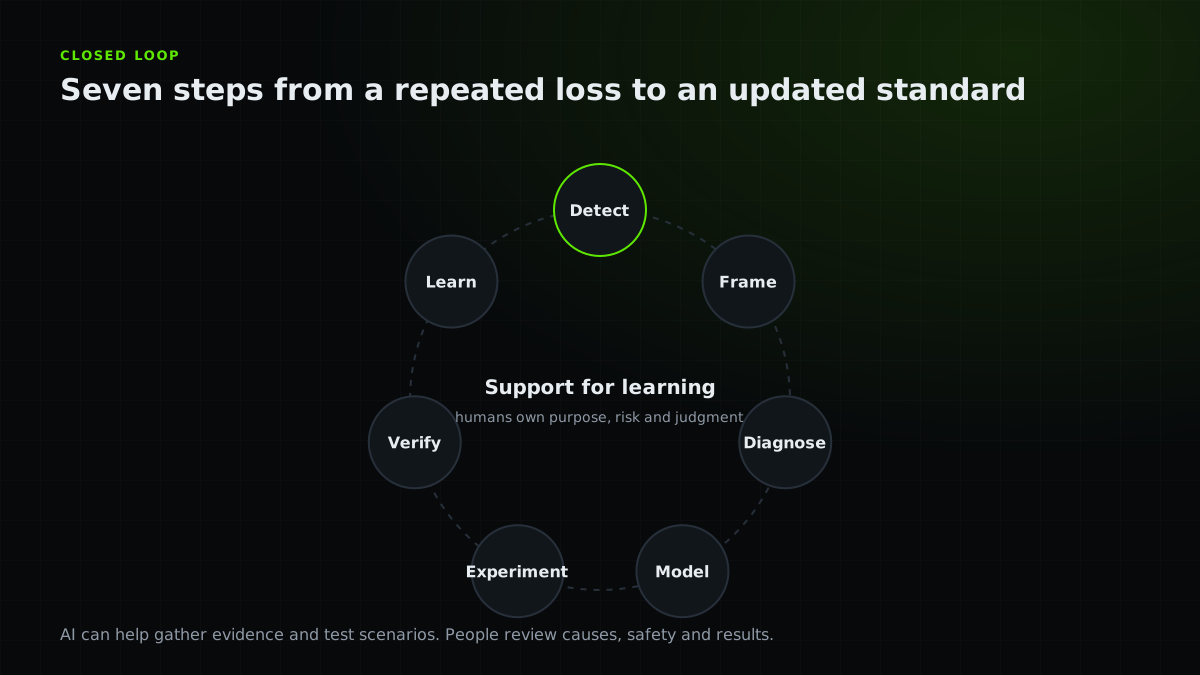
| Step | What happens | Where AI helps |
|---|---|---|
| 1. Detect | A repeated loss, drift, bottleneck or quality change is noticed | Watching many signals continuously; flagging patterns |
| 2. Frame | The gap is stated with a boundary and an impact | Drafting a problem statement from evidence |
| 3. Diagnose | Causal candidates are generated and tested | Timelines, similar cases, ranked candidates. See AI root cause analysis |
| 4. Model | Propagation and trade-offs are estimated | Running scenarios; comparing options |
| 5. Experiment | The smallest safe test is designed and run | Suggesting test designs; people decide |
| 6. Verify | Prediction is compared with the actual result | Comparing before and after, watching recurrence |
| 7. Learn | Standards and knowledge are updated | Retrieving and linking the record for future cases |
What humans still own
People decide which problems matter, which risks are acceptable and who is responsible for the result. Faster analysis does not remove those responsibilities.
- Purpose: which customer or system problem is worth solving.
- Risk and safety: what is allowed to change and what is not.
- Causal judgment: whether a candidate cause is convincing.
- Acceptance of the countermeasure: who is accountable if it fails.
- Policy and standard-work changes: what the plant commits to doing differently.
Where an AI-assisted loop fails
Check data consistency and record a baseline before testing AI-assisted analysis. Without those records, the team may be unable to compare the result. Test a proposed cause before extending the change across the process.
Keep the discipline of PDCA: a prediction before the test and a comparison after. A Kaizen event can use AI-assembled evidence and still needs the people at the process to test the change. See also continuous improvement in manufacturing for the surrounding management system.
- Baseline
Record the current result before anything changes.
- Prediction
State what should happen and how you would know if you are wrong.
- Test
Run the smallest safe change.
- Check
Compare the result with the prediction, including side effects.
- Standardize
Update standard work only for what the evidence supports.
Keep the investigation and result connected
Keep the problem, evidence, proposed test and result connected, even when different tools handle each step. Otherwise the next team has to reconstruct why the change was made. Deloitte’s 2026 survey of more than 140 manufacturers found that 84% report measurable AI value but only around 20% of use cases are scaled. This gap is consistent with integration and governance challenges, but the percentages alone do not establish their cause. The agentic AI guide covers how much autonomy each step can safely take.
A related example from Abolfazl
Check what changes when the same AI pilot moves to a second plant.
In English, on founder Abolfazl’s personal blog. This is related reading, not an independent technical source.
Practical checklist
- Map your current improvement process to the seven steps.
- Find the slowest step and ask whether evidence gathering causes the delay.
- Use AI to assemble evidence and rank candidates, not to close the loop.
- Record a baseline before every change.
- State a prediction before every test.
- Keep people accountable for purpose, risk, cause and acceptance.
- Verify against the prediction over a representative window.
- Update the standard and the knowledge record after each cycle.
FAQ
FAQ
Sources and further reading
Authoritative references used to research and verify this guide.