

 Abosh
Sales and operations planning, or S&OP, brings demand, supply and financial choices into one agreed plan. Sales and operations execution, or S&OE, handles shorter-horizon changes within that direction and escalates exceptions it cannot resolve. The useful distinction is the decision and time horizon, not the meeting name. Record demand, usable capacity, constraints and the owner of each trade-off. A balanced aggregate plan still needs a feasible detailed schedule before anyone promises a delivery.
Separate the planning decision from daily execution recovery.
Expose an aggregate capacity gap with declared assumptions.
Keep approved trade-offs and escalation rules visible.
Start with the decision the meeting must make
S&OP asks which demand and supply plan the business will support, including inventory, service, resources and financial consequences. S&OE deals with near-term imbalances such as a delayed component or a priority change. ASCM’s execution discussion distinguishes that shorter horizon from the wider planning role.
Some organizations use SIOP to name sales, inventory and operations planning. The extra letter draws attention to inventory; it does not by itself prove a different universal process. Write down your decision rights, horizon and escalation boundary instead of assuming the acronym supplies them.
| Decision | S&OP | S&OE |
|---|---|---|
| Main task | Agree the demand, supply and financial plan. | Resolve near-term order, material and capacity exceptions. |
| Horizon | Product families and resources beyond the immediate schedule. | The orders and constraints in the near-term plan. |
| Usual cadence | Often monthly, adjusted to the business. | Often weekly or more frequently as conditions change. |
| Who decides | The executive plan owner, with demand, supply and finance input. | The execution team, within its agreed authority. |
| When to escalate | Reconsider the plan when its objectives or limits must change. | Refer exceptions that exceed agreed service, inventory, cost or capacity limits. |
ASCM’s six steps are a useful named model
ASCM’s S&OP explanation runs from forecasting and demand planning through supply planning, a pre-S&OP review, an executive decision, then finalization and implementation. It is a named explanation, not a requirement that every business holds six separate meetings.
The handoffs matter. A forecast becomes a demand proposal; the supply review tests its constraints; financial and service trade-offs reach someone authorized to decide. Implementation needs owners and a review, not just an approved slide.
Work the gap before promising the volume
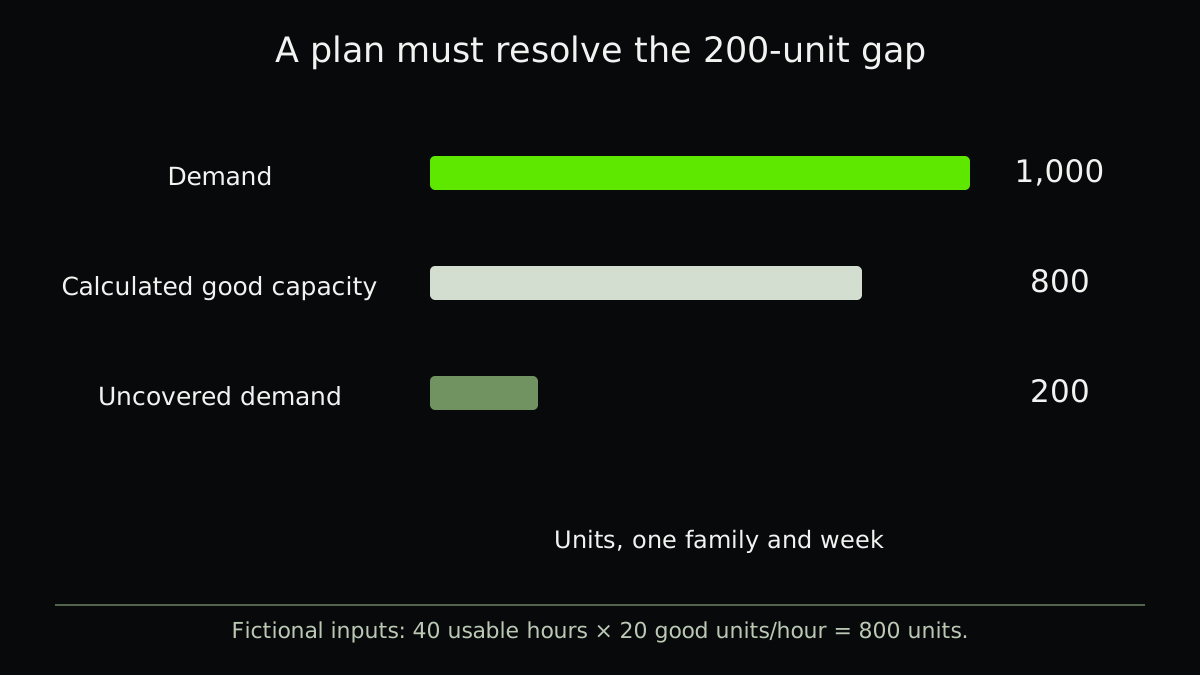
A fictional product family has demand of 1,000 units for next week. Its constrained process has 40 usable hours and an assumed sustainable rate of 20 good units per hour for that mix. Feasible output under those inputs is 800 units, leaving a 200-unit gap.
The rate is a teaching assumption, not a machine nameplate rate. Confirm staffing, material, setups, quality and maintenance allowances before using it. Aggregate hours cannot tell you whether each individual order meets its deadline.
For the 200-unit gap, the execution team can test sequencing and priorities within the agreed limits. Those checks do not create extra capacity. If the delivery promise, capacity commitment or approved cost limit must change, the plan owner must decide before the team issues a new promise.
| Input or result | Fictional value | Boundary |
|---|---|---|
| Demand | 1,000 units | One product family, next week |
| Usable constrained time | 40 hours | Same period and mix |
| Good-output rate | 20 units/hour | Assumed sustainable rate |
| Calculated capacity | 800 units | 40 × 20 |
| Uncovered demand | 200 units | 1,000 − 800 |
Cadence follows the horizon and volatility
A regular monthly S&OP cycle and weekly or more frequent S&OE review are common arrangements described by ASCM, not universal timing rules. A daily recovery meeting cannot substitute for a decision about capacity that takes months to create.
An urgent 100-unit order should trigger a check of what it displaces, not quietly become another promise. Escalate when the change exceeds agreed service, inventory, cost or capacity limits. Preserve the prior approved plan so the consequence remains visible.
Carry the plan into a schedule you can execute
S&OP can fail when demand versions disagree, capacity assumptions go unchecked, decision authority is missing or approved trade-offs never reach execution. Check those failure paths in the local record. Another meeting will not repair a missing owner or a promise the operation cannot meet.
The capacity-planning guide tests the relevant resource boundary. Detailed scheduling handles sequence, calendars, readiness and due dates. A total of 800 feasible units does not establish that every needed variant can be produced in time.
Use schedule attainment and delivery evidence to learn what happened. Separate forecast error, supply deviation and authorized priority changes rather than blaming all misses on one planning meeting.
- Align the demand record
Name family, horizon, orders, forecast and uncertainty.
- Test supply constraints
Use good-output capacity and actual material/readiness limits.
- Make the trade-off explicit
Assign authority for extra capacity, inventory or changed commitments.
- Check execution and escalate
Keep the prior plan, new exception and customer consequence together.
A related example from Abolfazl
Follow a demand change through a frozen schedule and its existing commitments.
In English, on founder Abolfazl’s personal blog. This is related reading, not an independent technical source.
Practical checklist
- Name the planning horizon and decision.
- Use consistent product families and units.
- Separate forecast demand from firm commitments.
- Check usable constrained capacity and material.
- Show the uncovered gap before choosing an option.
- Assign approval for service, cost and inventory changes.
- Preserve plan revisions and execution exceptions.
- Review delivery and quality, not meeting completion.
FAQ
FAQ
Sources and further reading
Authoritative references used to research and verify this guide.