

 Abosh
Material requirements planning, or MRP, calculates time-phased component needs from demand, bills of material, usable stock, planned receipts and lead times. A master production schedule, or MPS, sets the quantities and timing of selected master items that feed that calculation. ERP is the broader business system; DRP plans replenishment across distribution locations. A material proposal is only one part of the promise. Check capacity, readiness and sequence before treating it as an executable factory schedule.
Keep MPS, MRP, ERP and DRP responsibilities distinct.
Recalculate a small net requirement and release date by hand.
Find the capacity and data checks a material plan cannot replace.
The master item drives dependent component demand
An MPS makes selected finished products or important assemblies explicit in the plan. MRP then follows the bill of material to calculate component demand. SAP’s documentation describes these roles for its stated ERP and S/4HANA products; configuration and terminology can differ elsewhere.
For the fictional example, the master schedule requires 50 finished housings. Each uses two brackets. That creates 100 brackets of gross dependent demand. The calculation assumes the correct bill revision, full yield and no additional scrap allowance.
Net the right supply at the right date
Twenty usable brackets are available, and a confirmed receipt of 30 is due before the component need on Thursday. Under this simple example there are no other commitments, safety-stock target, minimum lot or rounding rule. Net additional requirement is 100 − 20 − 30 = 50 brackets.
With a two-working-day procurement lead time and no intervening closure, a Thursday requirement needs a Tuesday release. Different receipt timing, calendars or processing allowances change that date. Supply arriving after the need cannot cover it merely because the weekly total balances.
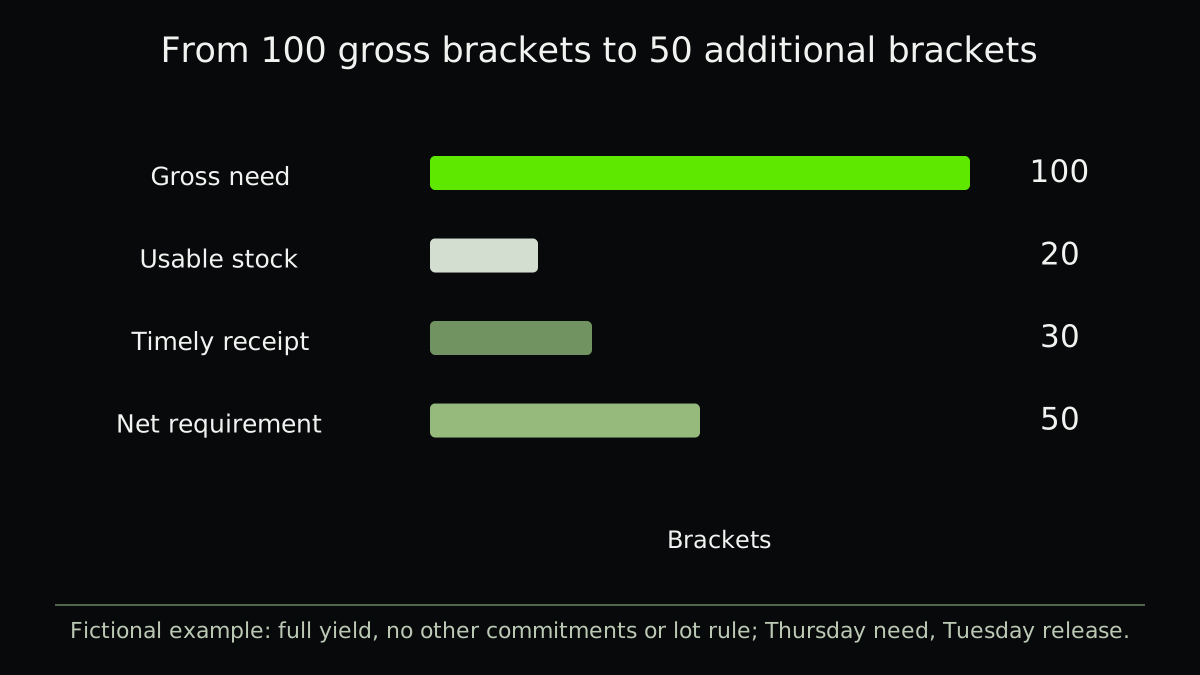
| Item | Brackets | Timing or assumption |
|---|---|---|
| Gross requirement | 100 | 50 housings × 2 |
| Usable on hand | 20 | Available for this need |
| Confirmed receipt | 30 | Before Thursday’s need |
| Net additional requirement | 50 | No other stock or lot rule |
| Planned release | 50 | Tuesday for Thursday need |
ERP, MRP and DRP answer different planning questions
ERP connects business functions such as orders, purchasing, inventory and finance. MRP is a planning function that can run within an ERP system. SAP supplies ERP products with MRP capabilities; asking whether SAP is one or the other mixes a vendor with a system category and a planning method.
Distribution requirements planning, or DRP, plans replenishment through a distribution network. SAP’s supply-chain documentation describes the distribution structure and time-phased replenishment needs. MRP instead follows production component requirements. They can exchange requirements, but a warehouse replenishment relationship is not the same as a manufacturing bill of material.
The meaning of three planning types depends on the classification
Strategic, tactical and operational planning describe horizons and decision scope. Make-to-stock, make-to-order and assemble-to-order describe different fulfillment arrangements. Neither is a universal list of three software runs, and they should not be mixed into one hierarchy.
Name the model you mean. In this guide the boundary is material planning from a selected master schedule to a dated component proposal. The wider S&OP process addresses demand/supply trade-offs, while detailed scheduling tests resource sequence and calendars.
Run the readiness checks before releasing work
A stock record may include held, obsolete or already allocated material. A bill can be wrong. A lead-time setting can lag current supplier behavior. Retain those states instead of letting a clean planning run hide them.
Even when every bracket is ready, two jobs may need the same machine at the same time. The capacity-planning guide explains the usable-resource boundary. More material cannot repair an overloaded constraint.
- Check the master demand
Confirm item, quantity, revision and due event.
- Check bill and usable supply
Separate holds, allocations and receipts that arrive too late.
- Recalculate dates and quantities
Include calendars, yield and actual lot rules rather than the example’s simplified assumptions.
- Test finite execution
Check people, equipment, setups and release readiness before committing.
A related example from Abolfazl
Follow a demand change through a frozen schedule and its existing commitments.
In English, on founder Abolfazl’s personal blog. This is related reading, not an independent technical source.
Practical checklist
- Identify master items and their due events.
- Confirm bill revision and units per assembly.
- Keep unusable and allocated stock separate.
- Time receipts against the actual need date.
- Declare yield, safety stock and lot rules.
- Use working calendars for lead-time offsets.
- Reconcile changed proposals without duplicate supply.
- Check finite resources before releasing work.
FAQ
FAQ
Sources and further reading
Authoritative references used to research and verify this guide.